
Algidex Patch Review: Does DeRoyal's Silver Catheter Dressing Work?
 By Anna Krause November 18, 2026
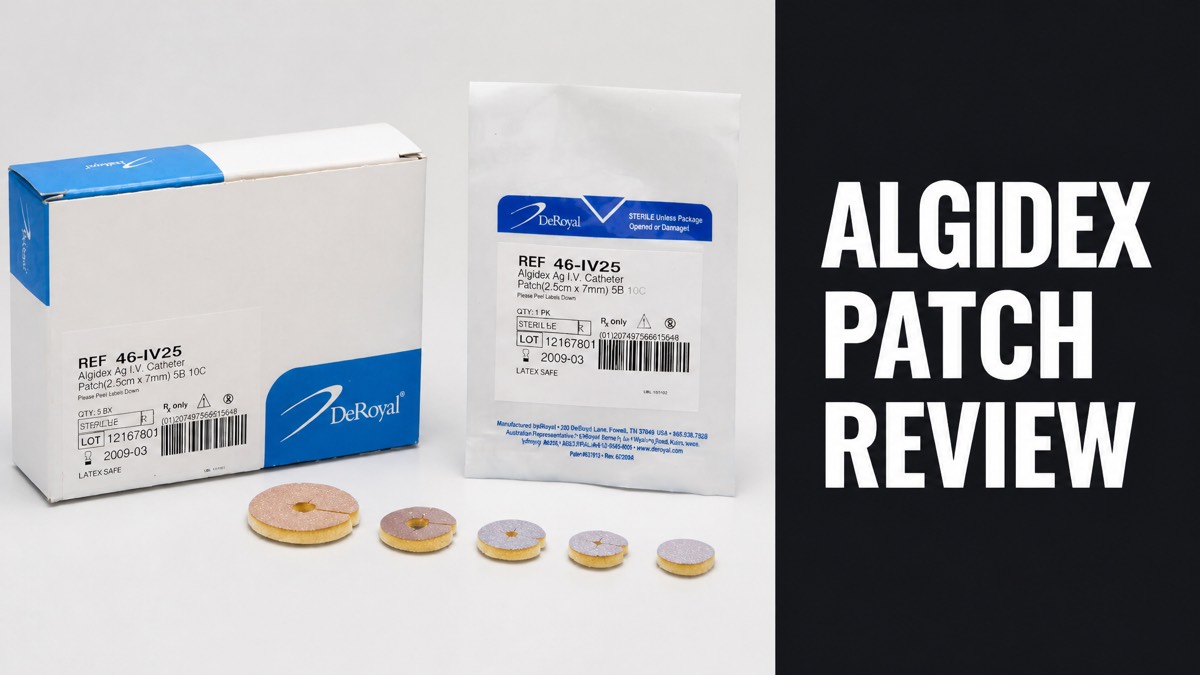
Algidex Patch is the common name for the DeRoyal Algidex Ag I.V. Patch, a sterile foam disc that sits around a catheter insertion site. The patch carries ionic silver and maltodextrin in an alginate matrix. Medical supply retailers sell it in several sizes and pack counts online.
The patch absorbs moisture and gives up to seven days of antimicrobial cover. The patch needs no activation, and gauze, film, or tape holds it in place. Listings name MRSA, E. coli, and Pseudomonas among its targets. Price runs from roughly $7 to $13 per patch, depending on pack size and seller.
Evidence comes mostly from product descriptions and a few buyer accounts, not large trials. The guide below covers contents, uses, and who should avoid the patch. Later sections compare it with chlorhexidine dressings and weigh the price, so you can judge whether it fits your needs.
What Is Algidex Patch?
Algidex Patch is a sterile silver alginate foam disc that sits around a catheter insertion site. DeRoyal Industries makes it under the full name Algidex Ag I.V. Patch. The goal is simple: lower the risk of catheter related infections.
The disc is polyurethane foam with a coating of ionic silver alginate and maltodextrin. The foam absorbs moisture around the site. A small hole in the center lets the catheter pass straight through.
Wear time reaches seven days. So one patch covers one dressing change cycle. So what makes it different from a plain foam pad? The silver coating, which is the whole point.
What Is in Algidex Patch?
The patch contains three working parts: polyurethane foam, ionic silver alginate, and maltodextrin. The foam forms the soft backing. Silver alginate and maltodextrin together form the matrix that releases silver at the site.
Here's the part most people miss: the silver is already in an active ionic state. The silver sits evenly through the matrix. Nobody needs to add sterile water to switch it on.
The patch is sterile and latex-free. Listings also call it non-staining and non-irritating. For a dressing that sits on fragile skin, those details matter.
What Sizes Does Algidex Patch Come In?
Algidex Patch comes in four main sizes, from 3/4 inch (19 mm) to 1.5 inch (38 mm). Opening width runs from 2 mm to 7 mm. Which opening is right? The one that matches the catheter width.
One 1 inch (25 mm) version ships with an insert, listed as 46-IV32. Packs hold 5 patches per box or 50 per case.
Size Guide:
| Item | Disc | Opening |
|---|---|---|
| 46-IV20 | 3/4 inch (19 mm) | 2 mm |
| 46-IV22 | 1 inch (25 mm) | 4 mm |
| 46-IV25 | 1 inch (25 mm) | 7 mm |
| 46-IV375 | 1.5 inch (38 mm) | 7 mm |
| 46-IV32 | 1 inch (25 mm) | 4 mm with insert |
How Does Algidex Patch Work?
Algidex Patch releases ionic silver at the catheter exit site. Silver acts against the bacteria that gather there. At the same time, the foam absorbs moisture. Why does dryness matter? A drier site gives bacteria less to work with.
Application is simple. The silver side faces the catheter and skin. Gauze, transparent film, or tape holds the patch in place. The foam itself does not stick, so removal means lifting it off the catheter.
Does Algidex Patch Need Activation?
No. Algidex Patch works on contact and needs no activation step. Nobody wets it with sterile water first. Listings describe application as one step, and the silver starts working when the patch touches skin.
Why does that matter? A busy ward or a home infusion routine has little spare time. One less step means fewer chances to get a dressing change wrong.
What Catheters Is Algidex Patch Used On?
Algidex Patch fits many catheter and percutaneous sites. Dealer listings name a long list of devices. Central lines and peripheral IVs lead that list.
Listed Uses:
- Peripheral IV catheters
- Central venous lines
- Arterial catheters
- Dialysis catheters
- Epidural catheters
- Gastrostomy feeding tubes
- Non-vascular percutaneous devices
- External fixator pins
One dealer also lists first and second degree burns, donor sites, and surgical incisions. Those uses sit outside the core catheter job, so check with a clinician before trying them.
What Are the Benefits of Algidex Patch?
Algidex Patch offers a sustained antimicrobial barrier for up to seven days. That's the headline benefit. What does it mean in practice? One patch stays in place through a full dressing change cycle, so the site is not left bare between changes.
Handling is the second benefit. Application takes one step. The foam is soft against the skin. And the patch does not stick to the site on removal, which keeps dressing changes gentler.
One listing also states the patch is MRI compatible, with no heat and no image distortion. Ask the manufacturer to confirm this before any scan.
Main Benefits:
- Antimicrobial barrier for up to seven days
- One-step application with no activation
- Soft foam that does not stick on removal
- Sterile and latex-free construction
- Moisture absorption at the insertion site
Does Algidex Patch Fight Bacteria?
Yes. Algidex Patch targets MRSA, E. coli, Pseudomonas aeruginosa, and Staphylococcus aureus. Listings describe the barrier as broad spectrum. The silver contacts pathogens tied to catheter related infections.
One informal comparison exists. A medical student tested the patch against BioPatch from Johnson & Johnson. Both inhibited Staphylococcus aureus and MRSA. Algidex did better against Pseudomonas aeruginosa.
How strong is that evidence? The evidence is a single informal test, not a clinical trial. No large trial appears in the product listings. Buyers who need trial data should ask DeRoyal directly.
What Do Algidex Patch Reviews Say?
Algidex Patch earns strong marks from the few buyers who describe it. One retailer listing shows a perfect 5 out of 5 rating across 8 ratings. Is that score proof? The sample is small, so treat the score as a hint.
One home patient has a chlorhexidine allergy and a tunneled line for TPN. The recommended BioPatch was off the table. Algidex worked well, with no reaction at all.
A father of a very low birth weight newborn tells another story. His daughter needed a vascular catheter. The hospital team used the patch to help block infection at the site. She is now healthy and gaining weight.
What Are the Limits of Algidex Patch?
Algidex Patch has practical limits that buyers should know. The foam is non-adhesive. The patch needs gauze, film, or tape to stay put. So the patch is one layer in a dressing, not the whole dressing.
Supply is uneven. One retailer lists a size as backordered. The home patient above could not get the patch through a home health company and ordered online instead.
What is the bigger limit? Evidence. Most claims come from manufacturer and dealer descriptions. Real-world accounts are few. Silver or alginate sensitivity also rules the patch out for some people.
How Does Algidex Patch Compare to Chlorhexidine Dressings?
Algidex Patch relies on silver instead of chlorhexidine. Chlorhexidine dressings such as BioPatch use a topical antiseptic. Listings say chlorhexidine and betadine can be absorbed through the skin. Algidex is not absorbed into the body.
Both types inhibit common bacteria in the informal test above. The difference sits in the risk profile. Silver acts locally at the dressing surface. Listings tie that to fewer systemic effects.
Algidex Patch vs Chlorhexidine:
| Feature | Algidex Patch | Chlorhexidine Dressing |
|---|---|---|
| Active agent | Ionic silver and maltodextrin | Chlorhexidine |
| Absorbed through skin | No | Can be absorbed |
| Main sensitivity concern | Silver or alginate | Chlorhexidine allergy |
Is Algidex Patch Gentler on Skin?
Yes, for most users. Algidex Patch is described as non-irritating, with no reported contact sensitization. The foam is soft. The matrix does not stick to the site when lifted off.
The home patient with a chlorhexidine allergy backs this up. The patient reports no reaction to the patch. Why no reaction? Silver and chlorhexidine are different agents.
The exception is silver or alginate sensitivity. Anyone with a known reaction to either one should skip the patch.
Who Should Avoid Algidex Patch?
Algidex Patch is not for people with silver or alginate sensitivity. Several other conditions also rule it out. Dealer listings share one contraindication list.
Do Not Use On:
- Third degree burns
- Ulcers resulting from infections
- Lesions in patients with active vasculitis
- Patients with sensitivity to silver, silver compounds, or alginates
- Any site where the patch would be surgically implanted
Sellers state plainly that their pages are not medical advice. A doctor or nurse should confirm the patch fits the patient and the device.
Is Algidex Patch Safe?
Yes, when used as labeled. Algidex Patch is sterile, latex-free, and not absorbed systemically. Those traits explain why it appeals to patients who react to other antiseptics.
Safe use still depends on the right patient, the right site, and the right size. Seven days is the ceiling for wear. After that, lift the patch off the catheter and discard it per institutional protocol.
How Much Does Algidex Patch Cost?
Algidex Patch costs roughly $7 to $13 per patch for the 1 inch size. Single patches list at $10.30 and $12.99. An autoship price drops to $9.74. One retailer starts at $7.97.
Bulk buying cuts the price. A box of 5 runs $41.48 to $48.60. A case of 50 for the 1 inch, 4 mm size costs $345.00, or $6.90 per patch.
Pack Prices:
| Pack | Size | Price |
|---|---|---|
| Box of 5 | 3/4 inch (19 mm), 2 mm opening | $41.48 |
| Box of 5 | 1 inch (25 mm), 4 mm opening | $45.90 |
| Box of 5 | 1 inch (25 mm), 4 mm with insert | $48.60 |
| Case of 50 | 1 inch (25 mm), 4 mm opening | $345.00 |
| Case of 50 | 1.5 inch (38 mm), 7 mm opening | $488.75 |
Is Algidex Patch Worth the Price?
Yes. Algidex Patch costs under $1 a day at the case rate when worn the full seven days. One patch covers one dressing change cycle. For a sterile silver dressing, that is a modest cost.
Is the single-patch price fair too? At $10 to $13, the answer is still yes for most buyers. Shipping and stock gaps matter more than the sticker price.
Where to Buy Algidex Patch?
Algidex Patch sells through online medical supply retailers. Sellers include DME-Direct, Iron-Med, Shoplet, Health Products For You, Save Rite Medical, Medical Department Store, and Grayline Medical. An eBay listing also exists.
Stock changes often. One size shows as backordered at one store. Home infusion patients who cannot get the patch through a home health company can order from these retailers directly.
Why Buy From an Authorized Dealer?
Authorized dealers lower the risk of counterfeit or second-hand stock. DME-Direct lists itself as an authorized DeRoyal dealer. The dealer warns that unauthorized sites may sell counterfeit goods or old stock that does not perform as intended.
For a sterile catheter dressing, packaging matters. Check that the seal is intact and the expiry date is current before use. A torn pouch means a discarded patch.
Is Algidex Patch Worth It?
Yes. Algidex Patch is a good choice for a one-step, seven-day silver catheter dressing. The price is modest. The construction is sterile and latex-free. Short answer: it does its job.
The caveat is evidence. Support comes from product descriptions and a few buyer accounts, not large trials. Confirm fit with a clinician. Treat this review as general information, not medical advice.
Who Is Algidex Patch Best For?
Algidex Patch suits patients who need long-term catheter site protection without chlorhexidine. People with a chlorhexidine allergy are the clearest fit. The patch also suits care teams that want a simple, no-activation routine.
Anyone with silver or alginate sensitivity should look elsewhere. So should anyone whose clinician advises a different dressing. Size and opening width need to match the catheter.
Coffee Loving Card Makers is a reader-supported platform. Purchases made through our links may earn us an affiliate commission at no extra cost to you. Learn more.