
Transderm Scop Patch Review: Is It Worth It?
 By Anna Krause November 19, 2026
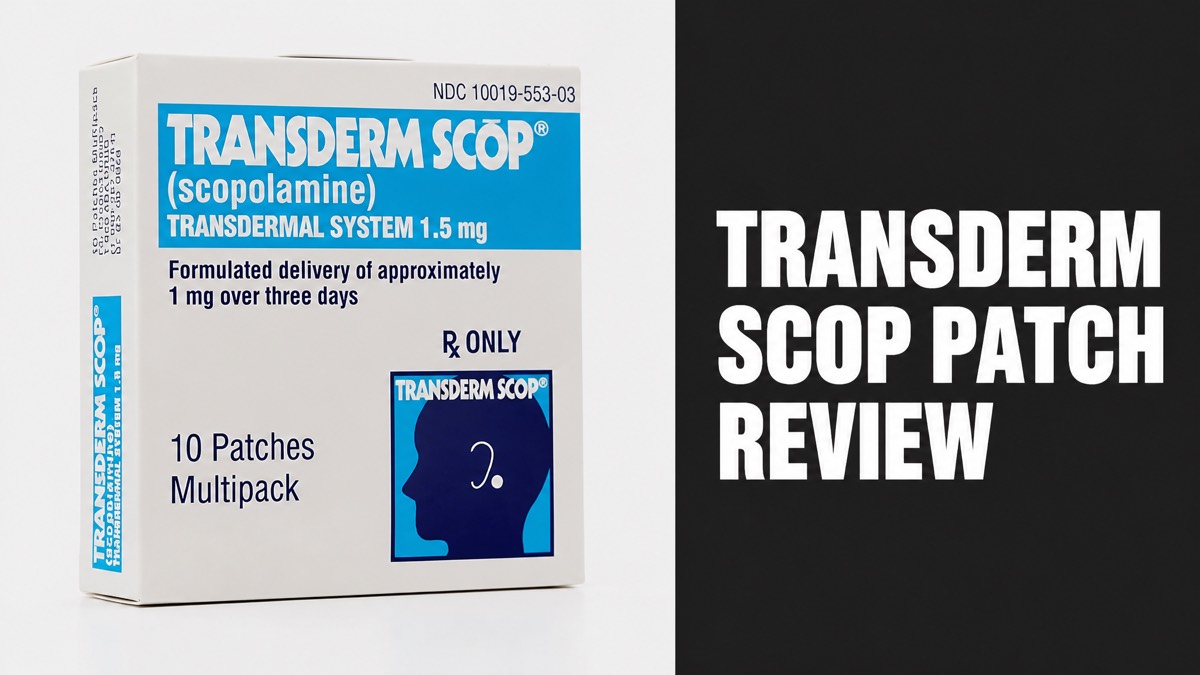
Transderm Scop is a prescription scopolamine patch that prevents motion sickness and nausea after surgery. The FDA approved it for adults in 1979. The round patch sits behind the ear and works for up to 3 days. Scopolamine is an anticholinergic agent. Generic versions deliver the same 1 mg dose over 3 days.
The patch blocks the nerve signals behind nausea and vomiting. The patch cut motion-induced nausea and vomiting by 75% in adult studies. Users rate it as mixed, with dry mouth, blurred vision and dizziness leading the complaints. Withdrawal can start 24 hours or more after removal. Dramamine and meclizine cost less and need no prescription visit.
The FDA added a heat warning in 2025 that matters most for children and older adults. Four patches cost about $31 to $35 at telehealth pharmacies. Read on for application steps and who needs to avoid the patch. Then see how the patch compares with Dramamine for a cruise or boat trip.
What Is Transderm Scop?
Transderm Scop is a prescription patch that prevents nausea and vomiting from motion sickness. The FDA approved it for adults in 1979. A later approval added nausea and vomiting that follow anesthesia or opioid pain medicine during surgery.
The round patch sits behind the ear and releases scopolamine for up to 3 days. What does the drug do? Scopolamine is an anticholinergic agent. Baxter Healthcare is the contact named on the current label.
To be clear, Transderm Scop needs a prescription in the United States. Pharmacies can't sell it over the counter. Online telehealth providers can evaluate patients and prescribe it.
Is There a Generic Version?
Yes. Generic scopolamine patches are available and deliver the same 1 mg over 3 days. The FDA confirms that scopolamine patches also come as generic products.
Generic pricing varies by pharmacy. For example, a Costco listing shows $74.59 for the generic. Discount-card prices start near $41 for ten patches.
How Does Transderm Scop Work?
Transderm Scop blocks the nerve signals that trigger nausea and vomiting. The label describes scopolamine as a competitive inhibitor at muscarinic receptor sites. The drug blocks cholinergic signals from the vestibular nuclei to higher brain centers.
Here's what the patch looks like inside: a film 0.2 mm thick with four layers. An aluminized polyester backing covers the top. A reservoir holds the drug, a membrane controls the release rate, and an adhesive layer touches the skin.
Each patch contains 1.5 mg of scopolamine and delivers about 1 mg over 3 days. How fast does it kick in? A priming dose releases first, and blood levels appear within 4 hours. They peak near 24 hours.
How Do You Apply the Patch?
Users apply one patch to the hairless skin behind one ear at least 4 hours before the effect is needed. A drug reference prefers a lead time of 12 hours.
Wash hands with soap and water after handling the patch. Never cut it, and wear only one at a time. Scopolamine that reaches the eyes dilates the pupils and blurs vision.
One patch lasts up to 3 days. What about a longer trip? Longer trips need a new patch behind the other ear. And when a patch comes off, fold it in half with the sticky sides together and discard it.
Steps:
- Wash hands with soap and water after handling the patch.
- Apply one patch to the hairless skin behind one ear at least 4 hours before the effect is needed.
- Wear only one patch at a time and never cut it.
- Replace it with a new patch behind the other ear after 3 days on longer trips.
- Fold the used patch in half with the sticky sides together and discard it.
Does Transderm Scop Work?
Yes. Transderm Scop reduces nausea and vomiting in clinical studies. In 195 adults tested at sea or in controlled motion, the patch cut motion-induced nausea and vomiting by 75%.
User ratings are more mixed than the trial data. Why the gap? Side effects and withdrawal complaints drive many of the low scores. The average across 88 user reviews is 6.4 out of 10, and 52% of those reviews are positive.
Short answer: the patch prevents symptoms and doesn't rescue a trip already underway. Timing decides the outcome. Nausea that has already started needs a different remedy.
Does It Prevent Motion Sickness?
Yes. The patch prevents motion sickness nausea and vomiting in adults. The efficacy studies recorded a 75% reduction in motion-induced nausea and vomiting at sea and in a controlled motion environment.
Cruise passengers report success. One traveler wore two patches on a week-long cruise and called the result great. Another user stayed free of seasickness but felt dopey on the first day.
Mild cases may not justify a prescription. Why not? UC Davis Health advises ginger candy and P6 acupressure bands first for mild motion sickness. Side effects typically outweigh the benefits of medication in those cases.
Does It Prevent Nausea After Surgery?
Yes. The patch lowers the rate of vomiting after surgery. In two studies of 391 adult women, 66% of treated patients had no retching or vomiting within 24 hours. Only 46% of placebo patients stayed clear.
Rescue medication use dropped as well. By how much? 76% of patch users needed no extra antiemetic in the first 24 hours. The placebo group reached 59%.
Surgery use follows a fixed schedule. Patients apply the patch the evening before surgery and remove it 24 hours afterward. Cesarean patients apply it 1 hour before surgery to limit newborn exposure.
What Do Transderm Scop Reviews Say?
Transderm Scop earns middling ratings from users. The average is 3.2 out of 5 across 189 reviews. A separate set of 88 reviews averages 6.4 out of 10. Experiences split between loyal travelers and users who dislike the side effects.
Motion sickness dominates the feedback. Of 189 reviews, 68 cover prevention of motion sickness and 67 cover motion sickness. Another 16 cover nausea after surgery.
Ratings vary by sample size. The set of 88 reviews is 52% positive. By comparison, a larger set of 212 reviews is only 42% positive.
What Do Users Like?
Users like that the patch keeps seasickness away for several days from one application. A week-long cruise needs only two or three patches.
Repeat users stay loyal. One passenger has worn the patch on 8 cruises and never had withdrawal. And a user on a first cruise had no seasickness at all.
The patch removes the dosing schedule. Users apply it once and move on. By comparison, Dramamine tablets need a dose every 4 to 6 hours.
What Are the Common Complaints?
Users complain most about dry mouth, blurred vision and dizziness. Among 88 user reviews, 26.1% mention dry mouth, 23.9% mention blurred vision and 20.5% mention dizziness.
Nausea appears in 35.2% of those reviews and vomiting in 13.6%. Why would a nausea patch show up with nausea? Several accounts place the nausea after patch removal rather than during wear.
Some exits are rough. One user felt dizzy and nauseous with blurry vision for 6 days after removal. A traveler on an 8-day cruise had no seasickness but felt nauseous 24 hours after removing the patch.
What Are the Side Effects of Transderm Scop?
The most common side effects are dry mouth, drowsiness, blurred vision and dilated pupils. The label lists each of these in more than 15% of motion sickness users.
Surgery patients report a similar set at lower rates. The label lists dry mouth, dizziness, drowsiness, agitation, visual impairment, confusion, dilated pupils and sore throat at 3% or higher.
Common Side Effects:
- Dry mouth
- Drowsiness
- Blurred vision
- Dilated pupils
- Dizziness
- Confusion
Rare reactions are more serious. The label names acute toxic psychosis, with confusion, agitation, hallucinations and delusions. Urinary retention and acute angle-closure glaucoma also appear on the warning list.
The FDA added a heat warning in June 2025. What's the concern? The patch can raise body temperature and reduce sweating. The agency counted 13 hyperthermia cases worldwide through August 2024. Four ended in hospitalization and 2 in death.
Can It Cause Withdrawal Symptoms?
Yes. Scopolamine withdrawal is possible, and the risk rises when the patch stays on longer than a few days. Symptoms include nausea, headache and blurred vision.
Symptoms can start 24 hours or more after removal. UC Davis Health describes this delay. And user accounts add dizziness, nausea and blurry vision.
Absorbed medicine stays in the body after removal. How long? Plasma levels fall with a half-life of 9.5 hours. The skin layers keep releasing some drug for a while.
Who Should Avoid It?
People with angle-closure glaucoma must not use Transderm Scop. The label also bars anyone with hypersensitivity to scopolamine or other belladonna alkaloids. Open-angle glaucoma needs monitoring because pupil dilation can raise eye pressure.
Several groups need extra caution. The label flags bowel, pyloric and bladder neck obstruction, seizure or psychosis history, and impaired liver or kidney function. Older adults face more central nervous system effects. Severe preeclampsia calls for avoidance.
Children fall outside the approved use. Why? The FDA notes that most serious heat-related cases involved patients 17 and younger. And adults 60 and older are also sensitive to temperature disruption.
Interactions matter. Thalidomide is contraindicated. Opioids, sedatives, alcohol, antihistamines including meclizine, tricyclic antidepressants and muscle relaxants add to the sedating and anticholinergic effects. Patients also remove the patch before an MRI.
Avoid or Ask a Clinician First:
- Angle-closure glaucoma
- Hypersensitivity to scopolamine or belladonna alkaloids
- Severe preeclampsia
- Children
- Thalidomide use
Transderm Scop vs Dramamine and Meclizine: Which Is Better?
Transderm Scop lasts longer than Dramamine but needs a prescription. One patch covers 72 hours. Dramamine is an over-the-counter tablet that works within 30 to 60 minutes.
Dramamine dosing runs one to two 50 mg tablets every 4 to 6 hours. The daily maximum is 8 tablets (400 mg). A 7-day cruise needs roughly 21 to 42 doses, versus 2 to 3 patches.
Meclizine sits between the two. Wandr Health describes 12 to 24 hours of coverage with less drowsiness than Dramamine. In fact, Dramamine Less Drowsy contains meclizine instead of dimenhydrinate.
Cost differs sharply. A bottle of Dramamine runs about $5 to $10, while four patches run about $35 with a coupon. Per day, that works out to $1 to $2 versus $2.90.
Transderm Scop vs Dramamine:
| Feature | Transderm Scop | Dramamine |
|---|---|---|
| Prescription | Required | Not required |
| Coverage | Up to 72 hours per patch | One to two tablets every 4 to 6 hours |
| Onset | At least 4 hours before travel | 30 to 60 minutes |
| Cost | $35 for four patches with a coupon | $5 to $10 per bottle |
Which Option Suits a Cruise?
Transderm Scop suits multi-day cruises and long boat trips. One patch lasts 3 days, so a week at sea needs two or three. Fewer applications mean fewer missed doses.
Dramamine suits short trips. The tablet works within 30 to 60 minutes. A day trip needs no prescription visit or advance planning.
Planning matters as much as the product. The patch needs at least 4 hours of lead time, and Wandr Health calls 8 to 16 hours optimal. Blood levels peak near 24 hours, so late application leaves the drug short of its peak.
How Much Does Transderm Scop Cost?
Transderm Scop costs about $31 to $35 for four patches at telehealth pharmacies. RedBox Rx charges $35 for four patches ($8.75 each). PlushCare quotes about $31 for four without insurance.
Larger packs cost more up front. Discount cards list ten patches from $41.39 and $44.96. Costco lists $74.59. Cost Plus Drugs lists $75.14 for a 30-count supply.
Transderm Scop Prices:
| Seller | Listed Price |
|---|---|
| RedBox Rx | $35 for four patches |
| PlushCare | $31 for four patches |
| WellRx | From $41.39 for ten patches |
| GoodRx | From $44.96 for ten patches |
| Costco | $74.59 |
| Cost Plus Drugs | $75.14 for 30 patches |
A prescription visit adds cost. An initial online visit runs $129 without insurance at one service and $39 at another. A traditional travel clinic consult costs $100 or more.
Where Can You Buy It?
Pharmacies and telehealth services sell Transderm Scop by prescription only. No over-the-counter version exists in the United States. Online providers evaluate patients by video and ship the patches.
Retail options include Costco, Amazon Pharmacy and discount-card pharmacies. Amazon Pharmacy lists generic scopolamine at $15.80 without insurance, against a retail price of $18.39. Pack sizes vary by listing.
PlushCare and RedBox Rx both offer telehealth routes. A provider reviews symptoms, decides on eligibility and sends an electronic prescription.
Is Transderm Scop Worth It?
Yes. Transderm Scop is worth it for healthy adults who need several days of motion sickness prevention. Bottom line: the patch cut nausea and vomiting by 75% in trials. Discount telehealth pharmacies charge about $8.75 per patch.
The trade-offs are real. Dry mouth, blurred vision and drowsiness hit more than 15% of motion sickness users. And withdrawal can arrive a day after removal. Heat-related risks weigh heavily for children and older adults.
Pros:
- 75% reduction in motion-induced nausea and vomiting in trials
- One patch covers 3 days
- About $8.75 per patch at discount telehealth pharmacies
Cons:
- Dry mouth, blurred vision and drowsiness
- Withdrawal a day after removal
- Heat-related risk for children and older adults
- Prescription required
Cheaper options exist for short trips. Dramamine and meclizine cost less and need no prescription visit. And ginger candy and acupressure bands cover mild cases.
Who Is It Best For?
Healthy adults on long cruises or boat trips get the most from Transderm Scop. The 3-day patch suits travelers who want one application per leg of the trip.
Travelers who need sharp focus have better options. The label warns about drowsiness, disorientation and confusion, and advises against driving or operating dangerous machinery.
Surgery patients use the patch under clinician direction. Parents and older adults need clinician advice first because of the 2025 FDA heat warning.
Coffee Loving Card Makers is a reader-supported platform. Purchases made through our links may earn us an affiliate commission at no extra cost to you. Learn more.